2.4.7 DBMS Monitoring : Cache
Table open cache
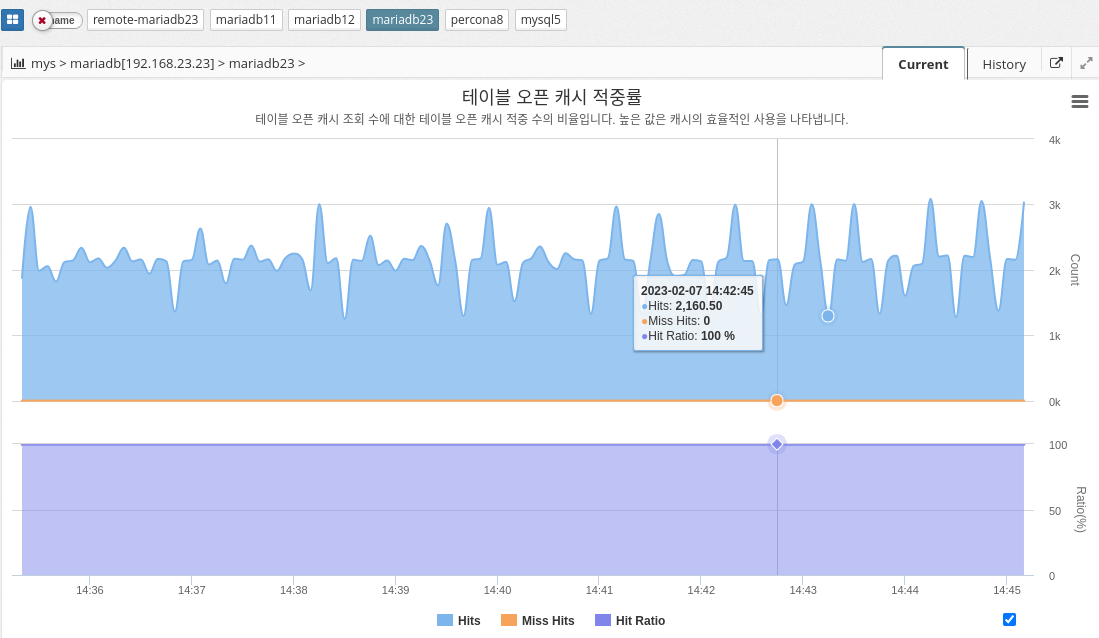
MySQL’s table open cache ratio indicates the percentage of tables that the MySQL server opens and caches in memory, relative to the total number of tables in the database. The table open cache ratio is a measure of the MySQL server’s efficiency in using memory to store frequently accessed tables and can affect the overall performance of the database.
In general, a high table open cache ratio means that more tables are being stored in memory, which can reduce the amount of disk I/O required to access the tables and speed up database queries. However, a high table open cache ratio also means that the MySQL server is using more memory, which affects the overall performance of the system and can lead to memory constraints if not managed properly.
To optimize the table open cache ratio, it is important to monitor cache usage and adjust the table_cache system variable as needed to ensure that the most frequently accessed tables are stored in memory. It is also important to track the overall memory usage of the system and adjust the available memory as needed to ensure that the MySQL server has enough resources to operate efficiently.
The parameter information used is shown below.
-
TABLE_OPEN_CACHE : Maximum number of tables deamon can open.
-
Calculated as
TABLE_OPEN_CACHE_HITS / (TABLE_OPEN_CACHE_HITS + TABLE_OPEN_CACHE_MISSES) * 100
Thread cache hit rate
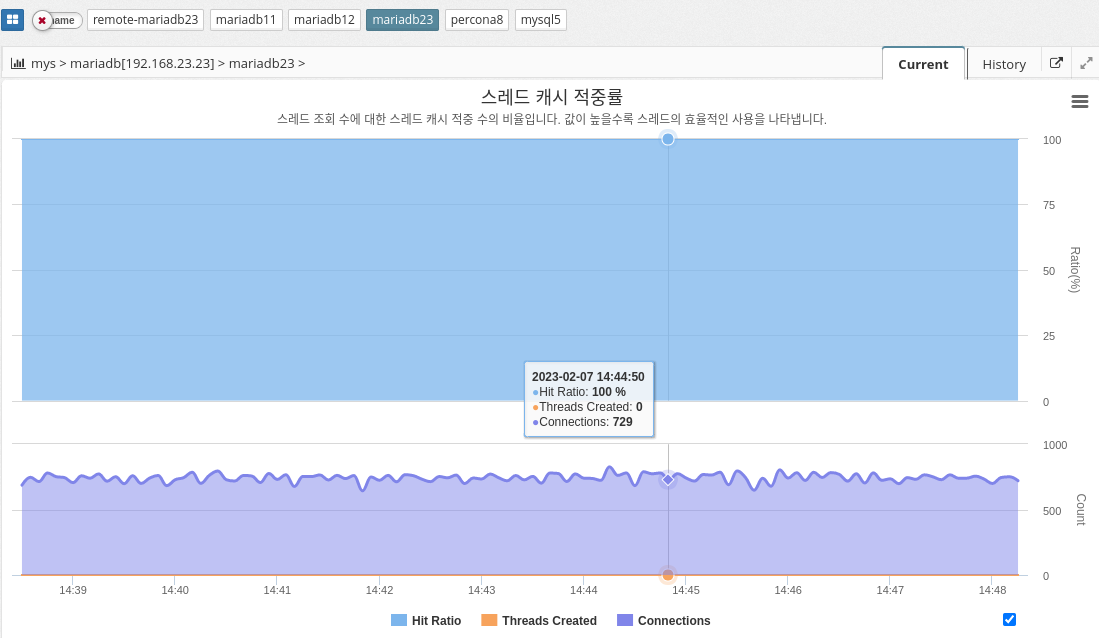
MySQL’s thread cache hit ratio is a performance metric that shows how efficiently the server uses the thread cache. It is calculated as the ratio of successful thread reuse to total thread creation requests. A high thread cache hit ratio indicates that the server is able to reuse threads efficiently and minimize the overhead of creating a new thread for each connection request.
A thread cache hit ratio of 100% means that all connection requests are being processed by cached threads, while a low hit ratio might indicate that the server is not using the thread cache efficiently, resulting in new threads being created for each request. This can reduce server performance.
To optimize the thread cache hit ratio, you can increase the size of the thread cache by adjusting the thread_cache_size variable in the MySQL configuration file. The larger the cache size, the more threads the server can reuse and minimize the overhead of creating new threads, which improves performance.
The parameter information used is shown below.
-
THREAD_CACHE_SIZE: The number of threads the daemon caches for reuse. Typically max_connections/100. See Connections and Threads_created.
-
SLOW_LAUNCH_THREADS: Number of threads whose thread creation took more than slow_launch_time.
-
Calculation
100 - threadsCreated / connections * 100
Binlog cache disk utilization
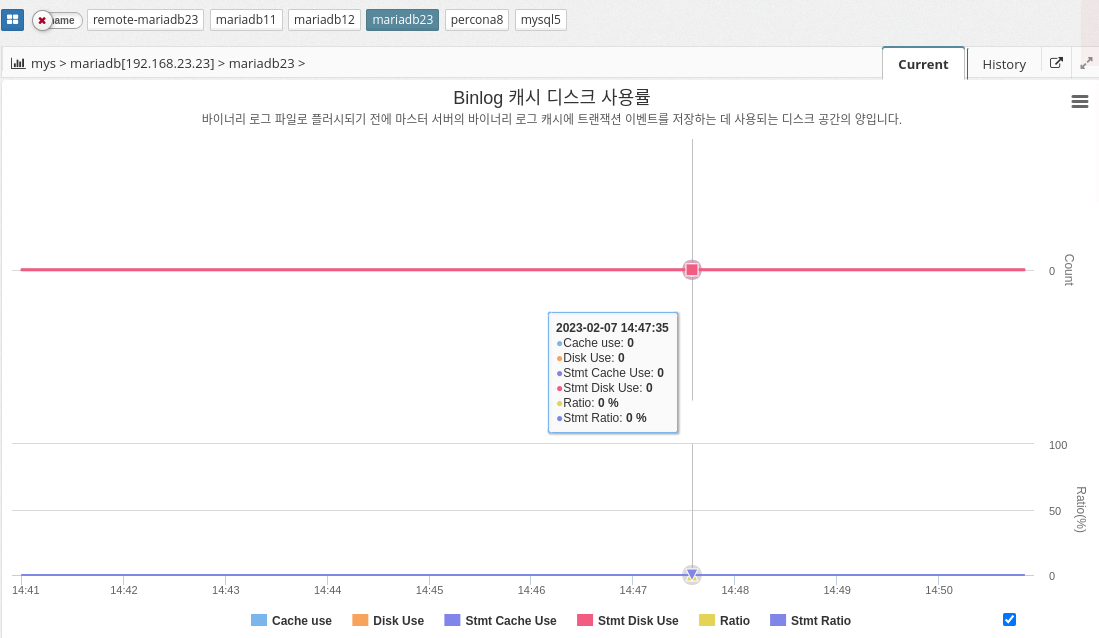
Binlog cache disk usage indicates the amount of disk space used by the MySQL database system to store binary log files. Binary log files, also known as binary log cache, are used to track database changes such as data insertions, updates, and deletions.
In MySQL, binary log files are stored on disk, and the amount of disk space required to store these files depends on the amount of database changes and the frequency of database transactions. The Binlog cache disk usage metric is important because it can affect the performance and reliability of your database system. High disk usage can result in slow database performance and increased disk I/O operations.
To reduce Binlog cache disk usage, administrators can optimize database configuration, such as increasing the cache size and regularly removing old binary log files. They can also use the Binary Log Rotate feature to automatically rotate and archive old binary log files to free up disk space and improve performance.
In conclusion, monitoring and optimizing Binlog cache disk usage is an important aspect of maintaining a healthy and efficient MySQL database system.
The parameter information used is shown below.
-
BINLOG_CACHE_SIZE : Caching memory size for binary logs per thread.
-
BINLOG_STMT_CACHE_SIZE : Cache memory size for statement (non-transaction) binary logs per thread.